Water Treatment Skill — RO/CIP Monitoring

RO/CIP monitoring for
membrane-cleaning skids.

Modulink connects to the 4-20 mA instruments already on your skid — pressure, flow, temperature, conductivity — and turns every cleaning run into a stage-aware cycle record: Clean, Soak, Flush, Rinse, per vessel, with the chemistry. Self-hosted on your site, no cloud dependency, in production at Falcon Water Technologies since 2025.

IN PRODUCTION — Falcon Water Technologies · Conroe, TX · RO membrane cleaning skids · since 2025 · Phase 3 signed · read-only ERP integration in production

Inside containerized RO water treatment system at Falcon Water Technologies — stainless steel vessels, blue pumps, and piping

RO cleaning skid interior — Conroe, TX

Modulink Terminal Indi mounted on RO skid with wiring to 4-20 mA loop instruments

Terminal Indi installed on-skid

Valve actuator on water treatment piping, controlled by Modulink Terminal Indi

Valve actuation on the cleaning loop

The Record

What a cleaning-cycle record actually needs.

When a customer, an auditor, or your own back office asks what happened on a skid last Tuesday, a clipboard note and a generic trend chart don't answer it. A defensible cleaning-cycle record needs four things:

Per-vessel pressure & flow

Differential pressure and flow rate on every vessel, read continuously from loop instruments across the whole cycle — not a single skid-level number.

Temperature & conductivity

Feed temperature and conductivity from 4-20 mA transmitters, logged in-line as the cycle runs — not reconstructed from lab samples afterward.

Stage boundaries

A record that knows when Clean ended and Soak began — every stage transition timestamped, per vessel, with the chemistry in use.

Exceptions on the record

Overpressure and overtemperature conditions surface as banners and alerts, and land in the same cycle record — not in a separate alarm log nobody joins to the data.

Supported Signals

Your instruments,
not a rip-and-replace.

Terminal Indi reads standard 4-20 mA loop instruments directly — the transmitters most skids already carry. Each Terminal has two 4-20 mA channels, so Terminal count scales with your loop count; a typical skid uses more than one. The instrumentation review maps exactly how many you need, and where.

Need to hand data to an existing SCADA or historian? The Base Station exposes MQTT, REST, and Prometheus, plus Modbus TCP as a Base Station integration — not a Terminal hardware feature.

  • PressurePressure transmitters, 4-20 mA loop
  • FlowFlow meters, 4-20 mA loop
  • TemperatureTemperature transmitters, 4-20 mA loop
  • ConductivityConductivity probes with 4-20 mA transmitters
  • Voltage inputs0-3.3 V analog channels for sensors without a current loop
  • OutputsH-bridge valve/motor drive · dry contact via relay

Terminal Indi: 2× 4-20 mA inputs · H-bridge actuator output · 9–36 V industrial power · on-site Wi-Fi/LAN (2.4 GHz). $500 per Terminal — see pricing.

How It Fits

Terminal Indi. Base Station. Water Treatment Skill.

Terminal Indi

Mounts on the skid, wires to your loop instruments, and drives valves or motors through its H-bridge output. Talks to the Base Station over your private on-site Wi-Fi/LAN — no cloud, no SIM cards. Shipped, in production.

Base Station

One on-site ARM64 server per site — dashboards, alerting, historian, user accounts, and audit log all run here, on your network. This is also where integrations live: Modbus TCP, and the read-only ERP feed pattern proven at Falcon.

Water Treatment Skill

The application layer that understands CIP: stage-aware dashboards, per-vessel state, cycle logging, overpressure/overtemp banners, alerts. $20 per Terminal per month, billed annually.

No telemetry leaves your site. No phone-home. If a Skill license lapses it goes read-only — the platform never bricks. See the platform and pricing.

Stage-Aware Records

Clean. Soak. Flush. Rinse.
Logged as stages, not soup.

Generic monitoring gives you one “running” light and a pile of trend lines. The Water Treatment Skill records the cycle the way an operator thinks about it: each stage gets its own state, its own readings, and its own timestamped boundaries — per vessel, with the chemistry in use, on skids up to 48 vessels.

Overpressure and overtemperature conditions raise banners and alerts as they happen, and land in the same record. The result is a cycle history your back office can consume directly — at Falcon, through a read-only ERP integration that deliberately never writes back.

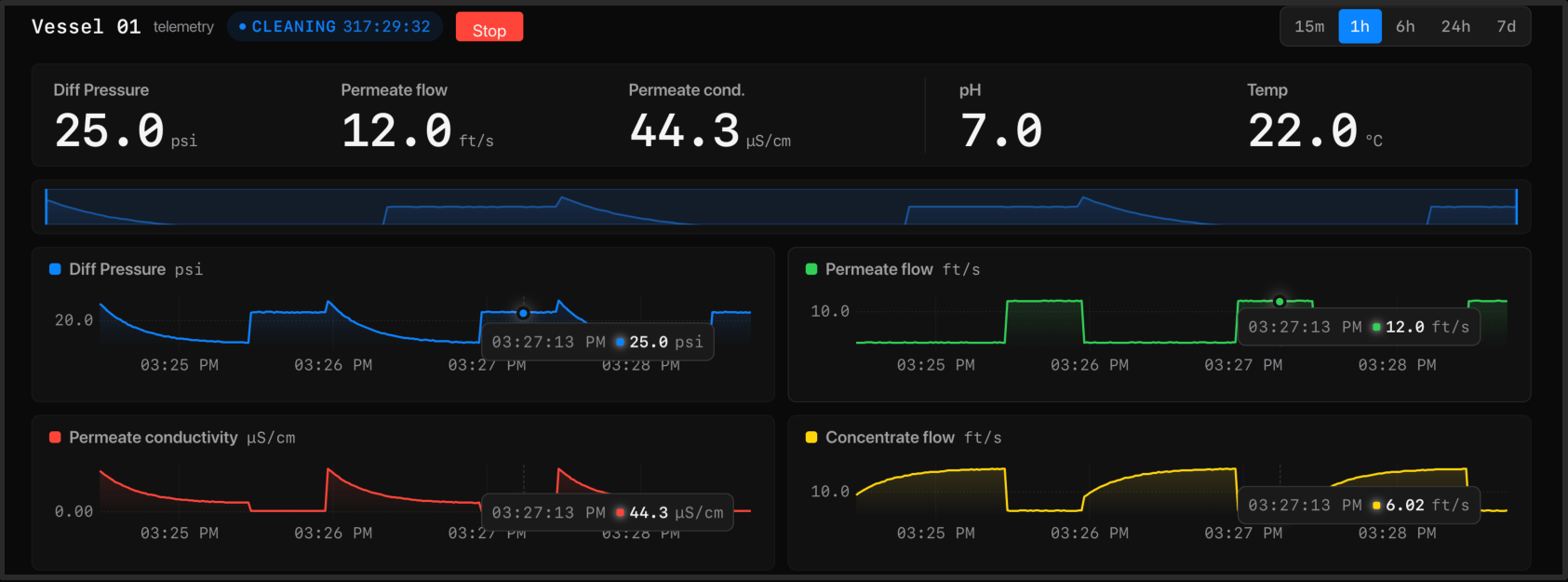
Modulink dashboard running live at Falcon Water Technologies, showing real-time pressure and flow telemetry from RO membrane cleaning skids

Live skid telemetry on the Base Station dashboard — running on-site.

Deployment

From P&ID to cycle records, in five steps.

01

Instrumentation review

We map your skid: which loops exist, which are missing, and how many Terminals the vessel count needs. This is the free first step — send us a P&ID or photos.

02

Terminals wired to your loops

Terminal Indi wires to existing 4-20 mA instruments — two analog channels per Terminal, 9-36 V industrial power, mounted on-skid.

03

Captive-portal commissioning

Each Terminal joins your on-site Wi-Fi/LAN through its own setup network — no mobile app, no truck roll for network config.

04

Base Station on your network

One on-site ARM64 server runs the dashboards, historian, alerting, and the Skill. No cloud dependency; air-gap capable.

05

Cycle records, live

The Water Treatment Skill starts logging stage-aware cycle records from the first cleaning cycle. Data egress via MQTT, REST, and Prometheus from day one.

Full commissioning detail on the deployment page. Installation services available at $200/hr.

Operating Boundary

What it is — and
what it deliberately isn't.

We'd rather you know the boundary before the sales call than after the install. Modulink is monitoring, documentation, and bounded non-safety-critical control — on your network, on your hardware.

Non-safety-critical control

Valve and motor actuation is bounded and non-safety-critical. Safety logic lives in Terminal firmware and your existing hardwired protections — never over the radio. Modulink does not carry E-stops or safety interlocks.

Wi-Fi/LAN prerequisite

Terminal Indi needs your site's 2.4 GHz Wi-Fi or LAN to reach the Base Station. That's a private on-site network — no cloud, no SIM cards, no carrier fees. If your skid bay has no coverage, that's a finding of the instrumentation review, not a surprise at install.

Local fallback

The Base Station keeps logging without an internet connection — the internet is never in the loop. If a Terminal loses Wi-Fi, it buffers telemetry locally and forwards when the link returns. Your data lives in the on-site historian, on hardware you own.

Worried about betting a process record on a small vendor? That's exactly why Modulink is self-hosted with open egress: your data sits in the on-site historian, exportable over MQTT, REST, and Prometheus, and if a Skill license ever lapses it degrades to read-only rather than bricking. More on the security & data ownership page.

In Production

Falcon Water Technologies, Conroe TX.

Falcon is an RO membrane-cleaning services company. Modulink has monitored their cleaning skids in continuous production since 2025, with stage-aware cycle records, overpressure/overtemp banners, and alerts running on skids up to 48 vessels.

The relationship is now Phase 3, and it's OEM-in-BOM: Modulink hardware is designed into Falcon's product bill of materials, not bolted on afterward. A read-only integration feeds cleaning-cycle data into Falcon's ERP — deliberately with no writes.

Read the Falcon case study
Rosemount 4-20 mA loop instrument used for water quality monitoring
Motorized valve and sensors on industrial water treatment skid
RO membrane corridor with filtration vessels and pumps
Control panel wiring on a water treatment skid

RO/CIP Pilot

Start with one skid.

The lowest-risk way to evaluate Modulink is a bounded pilot on a single cleaning skid: your existing instruments, a defined Terminal count, the Base Station on your network, and stage-aware cycle records from the first cleaning run. Scope, hardware, and pricing are laid out on the pilot page.

See the RO/CIP pilot scope

FAQ

The questions controls engineers actually ask.

Which signals can Modulink read on an RO/CIP skid?

Any loop instrument with a 4-20 mA output: pressure transmitters, flow meters, temperature transmitters, and conductivity probes are the typical CIP set. Terminals also accept 0-3.3 V analog inputs, and dry-contact outputs are available via a relay driven from the H-bridge. Modbus TCP is a Base Station integration for talking to existing SCADA — it is not a Terminal hardware input.

What does “stage-aware” mean?

The Water Treatment Skill knows a cleaning cycle has stages — Clean, Soak, Flush, Rinse — and records each one separately, per vessel, with the chemistry in use. Instead of one undifferentiated stream of numbers, you get a cycle record segmented by stage, with every state transition logged.

Does Modulink replace my existing PLC or SCADA?

No — it complements them. Your skid PLC and any hardwired interlocks keep running the process exactly as before. Modulink adds the monitoring and documentation layer: per-vessel telemetry, stage-aware cycle records, alerts, and open data egress (MQTT, REST, Prometheus, plus Modbus TCP at the Base Station) so existing SCADA can read what Modulink sees.

What happens when Wi-Fi or the internet fails?

The internet is never required — the Base Station runs entirely on your site and keeps logging with no internet connection at all. If a Terminal loses its link to the on-site Wi-Fi/LAN, it buffers telemetry locally and forwards it when the link returns. Safety logic lives in Terminal firmware, never over the radio, so a network outage never removes a protection.

What can be remotely controlled?

Bounded, non-safety-critical actuation only: valves and motors via the Terminal’s H-bridge output, or a relay for dry-contact loads. Every control action goes through role-based access control and is written to the audit log. Safety interlocks, emergency stops, and trip logic stay in hardware and Terminal firmware — they are never moved onto the network.

What is excluded?

Modulink is not for safety-critical control — no E-stops, no safety interlocks over the radio. There is no vendor cloud and no phone-home telemetry. The ERP integration is deliberately read-only: Modulink never writes into your business systems. And it does not replace your PLC — it documents and monitors the process your existing controls run.

Start with an instrumentation review.

Send us a P&ID, a photo of the skid, or just the vessel count. We'll come back with the loop map, Terminal count, and a scoped path to your first stage-aware cycle record.

Get the One-Pager