Precision Agriculture
You're irrigating blind.
Your soil knows better.
Most growers make water decisions from a calendar, a gut feeling, or a single surface probe. Meanwhile, what's actually happening at 12 inches looks nothing like what's happening at 36. You're either overwatering and paying for it, or under-watering and losing yield you'll never get back.
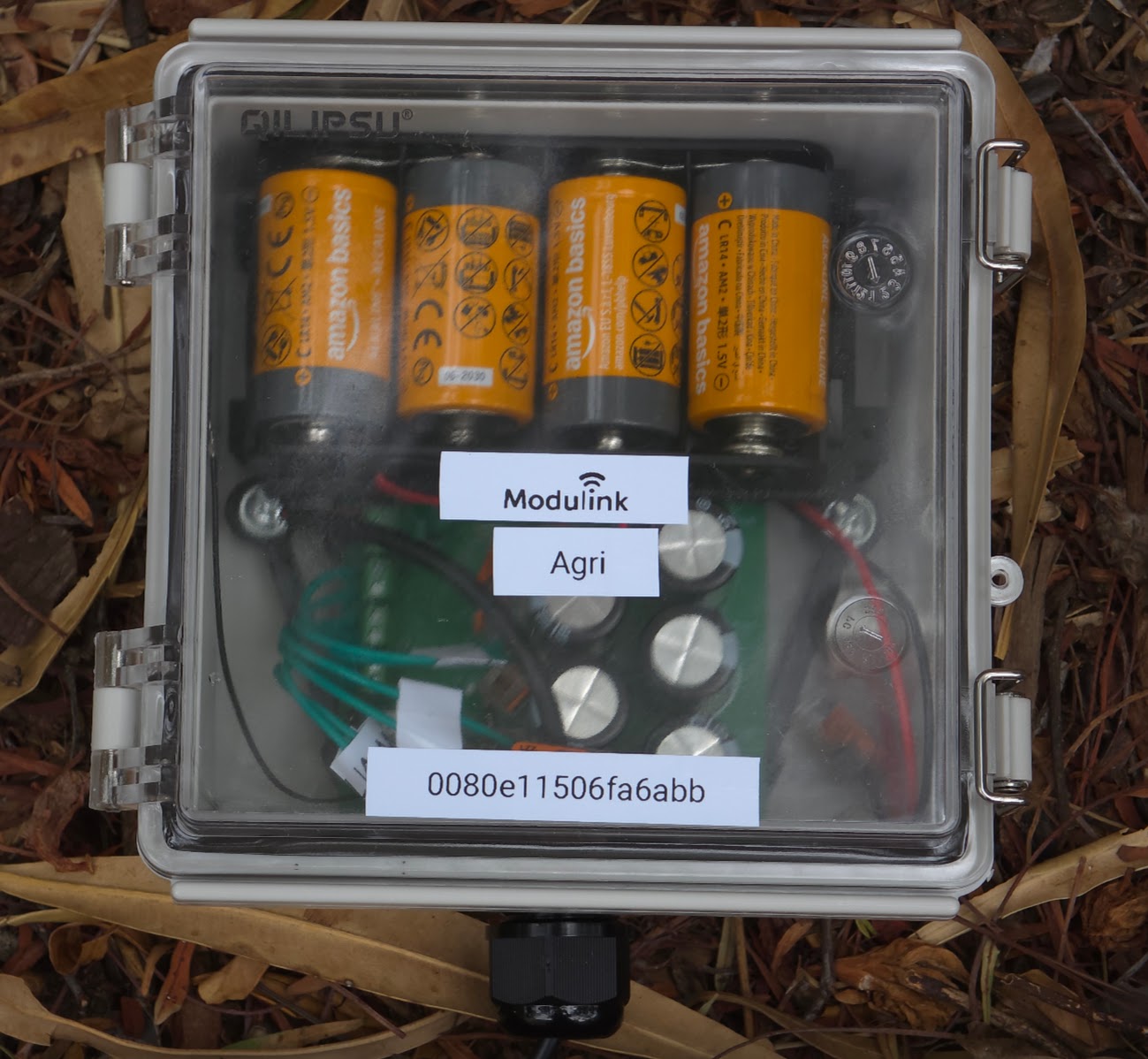
Modulink gives you the full picture — three soil depths, temperature, and valve control in a single wireless station. No trenching. No wiring. No cellular bills. Data on your phone, valves on your terms.
What Goes in the Ground
One station. Three depths. The whole story.
Each Modulink station reads soil moisture at three depths in the root zone — 12″, 24″, and 36″. Add a soil temperature sensor and an automated valve, and you've got a complete irrigation decision point for every zone on your farm.
Everything talks over private LoRa wireless — a network you own, with multi-mile range, no SIM cards, and no monthly fees. Stations run on battery or solar. Deploy in a morning.
Why It Matters
The problems you already know.
Water is money.
Whether you're managing allocations in Paso Robles, paying per acre-foot in Fallbrook, or pumping from limited catchment in Kona — every wasted gallon costs more than it did last year. Irrigating by schedule wastes 20–40% more water than irrigating by soil data. That's not our number — it's what USDA extension research shows consistently.
Shallow probes miss what matters.
A single probe at 6 or 8 inches tells you what's happening at the surface. It doesn't tell you whether moisture is reaching the deep root zone, or whether you're pushing water past it entirely. Three depths changes the conversation.
The damage happens underground.
Avocado root rot starts where you can't see it. Vine stress builds silently in the deep root zone. Macadamia blanks are decided weeks before harvest. Coffee cherries drop before you notice the deficit. By the time the canopy tells you something's wrong, the season is already decided.
You can't be everywhere.
Walking rows to check soil or driving to remote blocks to toggle a valve doesn't scale. It barely works. Your time is worth more than that.
What You Get
Today, not someday.
Real-time soil moisture at three depths.
See what's happening in the root zone right now. Trends over days, weeks, months. GPS-tagged stations on a map view so you know exactly which zone needs water and which doesn't.
Soil temperature.
Time your irrigation. Monitor frost risk. Track conditions during flowering and fruit development. One more data point that changes decisions.
Valve control from your phone.
Open and close irrigation valves remotely. No walking rows, no driving to the field. Built-in fault detection tells you if something's stuck.
Your data, your hardware.
The software runs on a base station at your site. Not in someone else's cloud. Your data stays on your farm. Works even if the internet goes down.
Roadmap
Where this is headed.
We're building toward automated irrigation — a system that learns your soil, integrates weather forecasts and satellite imagery, and makes watering decisions for you. But that takes real field data from real farms over real growing seasons. We don't ship algorithms trained on someone else's dirt.
The first step is deploying sensors, collecting data, and proving the value of ground-truth visibility. Automation comes when the data says it's ready — not before.
Crops We Work With
Built for specialty agriculture.
Deficit irrigation is an art. Three-depth data turns it into a science. Manage vine stress precisely, zone by zone, block by block. Works whether you’re in Paso Robles, Napa, Temecula, or Valle de Guadalupe.
Shallow, sensitive root systems on steep hillside groves. Overwater and you get root rot. Underwater and you get fruit drop. The margin between the two is narrow — three-depth data finds it.
Fast-draining volcanic soil, variable microclimates across elevation bands. Three-depth monitoring reveals what a single surface probe never could — how moisture behaves differently at every depth and every altitude.
Deep feeder roots and extreme water sensitivity during nut fill. The deficit that causes blank shells happens underground, weeks before you see it. Surface probes miss it entirely.
If it has roots and you’re paying for water, we can help.
Let's talk about your farm.
We work directly with growers — no distributor, no sales deck, no runaround. If you want ground-truth soil data and valve control without the six-figure SCADA quote, call or text anytime.
Russ Sobti · Founder