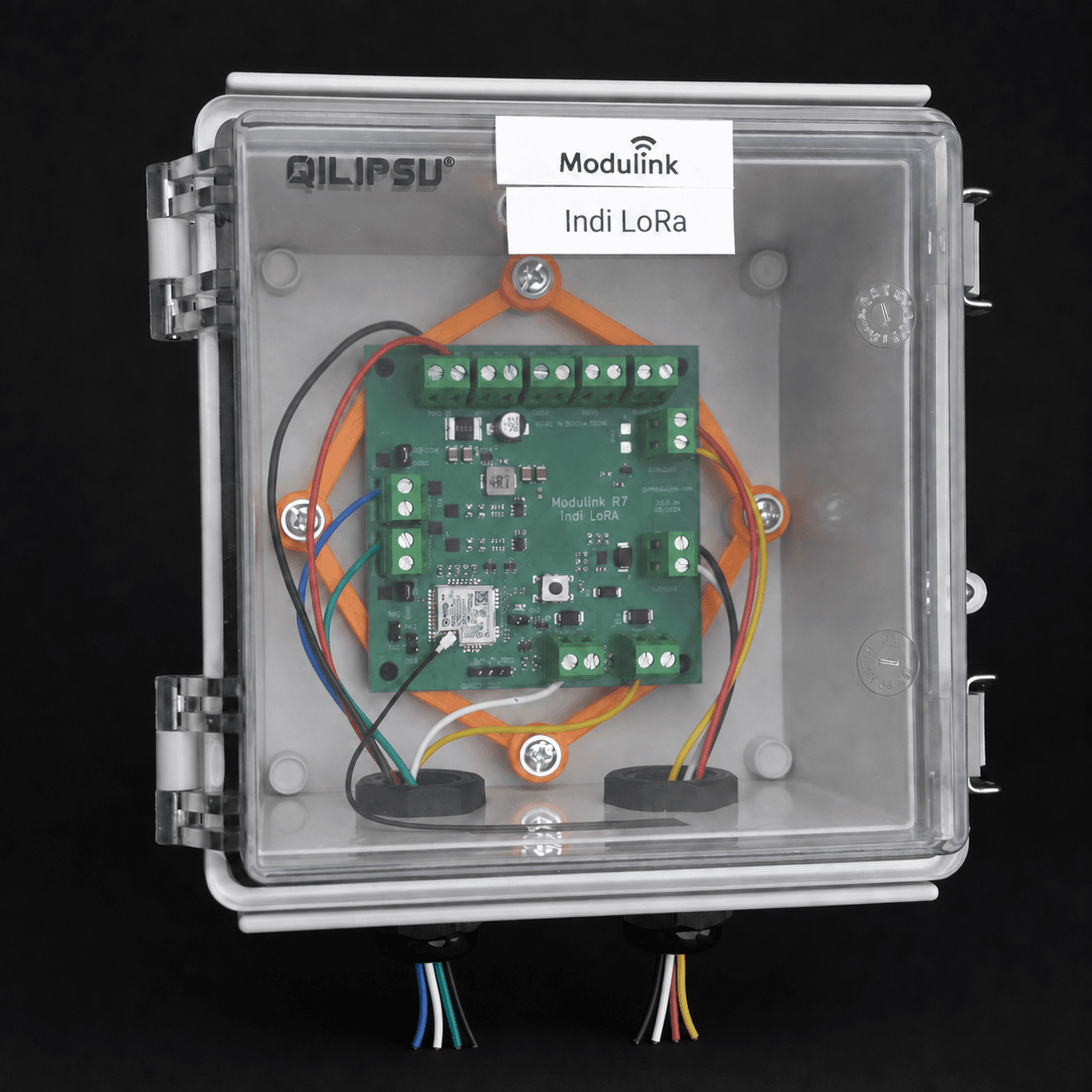
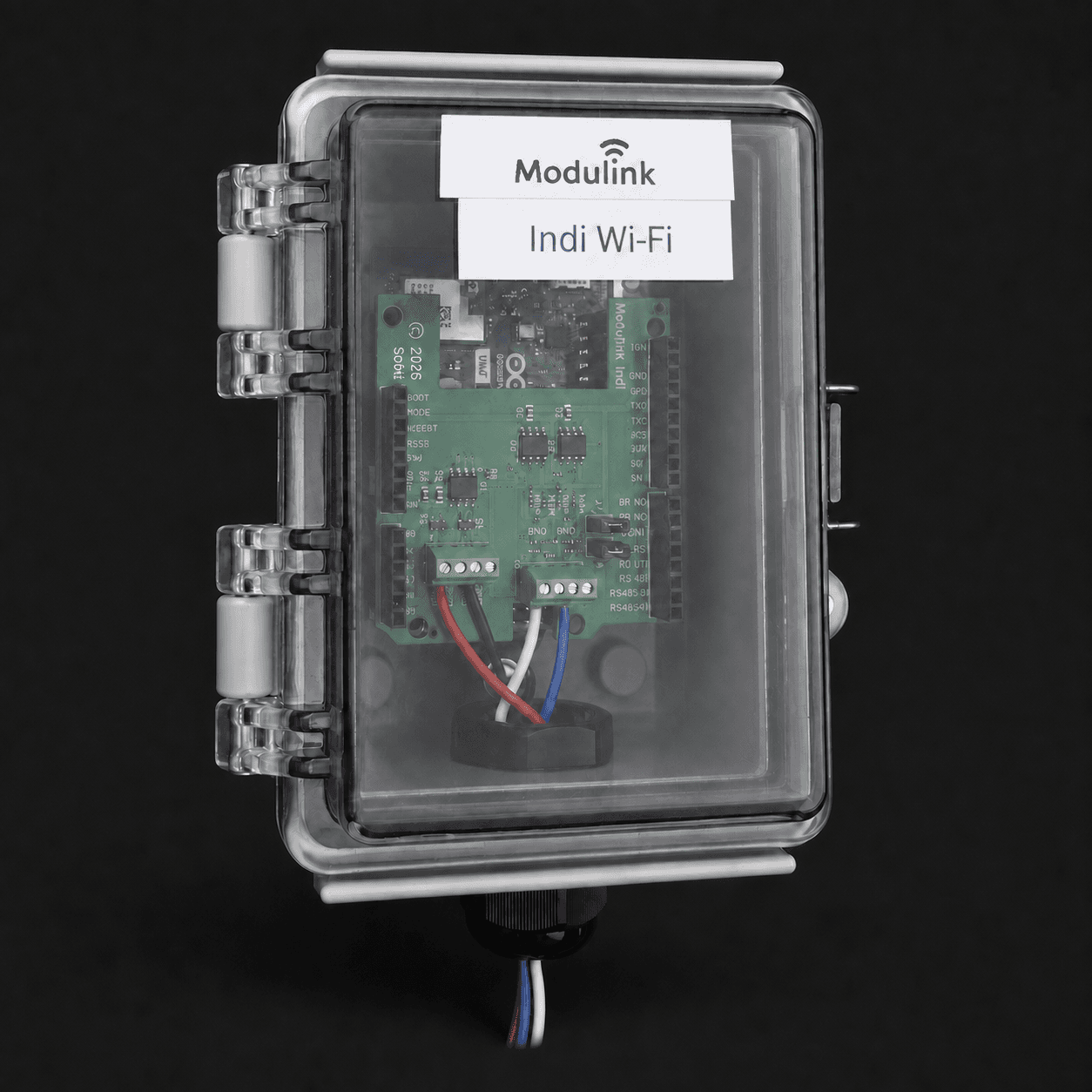
4-20 mA monitoring for instrumented water-treatment skids.
Terminal Indi is Wi-Fi/LAN plant field I/O — not a LoRa radio product. It reads your existing 4-20 mA loop transmitters and provides bounded, non-safety-critical valve and motor control, over the private 2.4 GHz Wi-Fi or LAN network your plant already has. No SIM, no cloud, no rip and replace.

Fit Check
Is Terminal Indi the right Terminal?
Modulink uses the right radio for the job — Indi is the Wi-Fi/LAN line for instrumented plants; Agri is the LoRaWAN line for open fields. Thirty seconds here saves a wrong-fit call.
Indi is a fit when
- Instrumented skids and process equipment with 4-20 mA transmitters already in place
- Sites within on-site Wi-Fi or LAN coverage — plant floors, pump houses, containerized systems
- Mains power available (9-36 V DC supply at the mounting point)
- RO/CIP cleaning skids, water-treatment trains, pump and lift stations, tank farms
Not a fit when
- Remote field sites beyond Wi-Fi coverage, or battery-only installs — that is Terminal Agri (LoRaWAN). See Terminal Agri
- Safety instrumented functions. Terminal Indi provides non-safety-critical control only — keep SIFs on your dedicated safety system.
I/O Interfaces
Built for process instrumentation.
Need to talk to a PLC or historian? Modbus TCP integration runs at the Base Station — the Terminal stays a clean field-I/O device.
Network Requirements
Runs on the network you already have.
Inside an instrumented plant, Wi-Fi/LAN is the right radio — the network is already there. Terminals join your private site network and report to the on-site Base Station. Nothing leaves your site unless you send it — see security & data ownership.
Commissioning
Connects like a printer. Works like a PLC.
A new Terminal broadcasts a captive-portal setup network. Join it from a phone or laptop, give it your site Wi-Fi credentials, and it finds the Base Station. No config files, no integrator quote, no truck roll.
Power up
Terminal broadcasts its captive-portal setup network.
Join
Connect from a phone; point it at your site Wi-Fi and Base Station.
Live
Telemetry lands on your dashboard in minutes.
Planning a rollout? See how deployment works.
The Base Station
The Terminal senses. The Base Station thinks.
Terminal Indi is deliberately a clean field-I/O device. Everything else — the historian, dashboards, alerting, user accounts, and Skill logic — runs on the on-site Base Station, one per site, with no cloud in the loop.
See the full platform architectureThe Safety & Latency Boundary
Non-safety-critical control, stated plainly.
Terminal Indi provides bounded, non-safety-critical control — opening a valve, setting a motor speed, closing a relay. Safety logic lives in Terminal firmware, local to the device. It is never carried over the radio, and no safety trip ever waits on a packet arriving on time.
Wi-Fi is not a deterministic path and we do not pretend it is. If your process needs a safety instrumented function — an emergency shutdown, a certified interlock — that belongs on a dedicated safety system, and Modulink sits beside it, not in place of it.
“But we need LoRa”
Then you need a different Terminal — not a different platform.
Modulink isn't married to one radio. Indi runs Wi-Fi/LAN because inside an instrumented plant the network is already there. For assets beyond Wi-Fi coverage — open fields, no power run — Terminal Agri runs LoRaWAN (US915) to the same Base Station. One platform, mixed fleets, per-line radios.
Both Terminal lines report to the same Base Station. If your site mixes an instrumented plant with remote assets, you don't choose a radio — you choose the right Terminal for each asset.
Edge Compute
Skill workloads at the sensor.
Terminal Indi can run containerized Skill workloads on-device — compute pushed down to the edge, next to the process it reads. This is a platform capability, not a shipped feature of any Skill.
We're recruiting design partners for the first edge Skills. If you have a signal that needs a decision made locally — before it ever reaches the Base Station — we want to build it with you.
Talk to us about edge SkillsUse Cases
Where Terminal Indi works.
RO membrane cleaning
Flow, pressure differential, temperature, and cleaning-stage timing. Every cycle documented, every anomaly flagged.
In production at Falcon Water TechnologiesPump & lift stations
Flow, pressure, and level on your phone, with alerts before failures. Stop driving the route to read a gauge.
4-20 mA connects to your existing transmittersTank level monitoring
Water, wastewater, and chemical storage. Real-time level with trend history and overflow alerting.
Read what a loop sensor already outputsPlant utilities
Generators, compressors, and HVAC inside plant Wi-Fi coverage but too far from the control room to hard-wire. If it has a loop sensor, the Terminal can read it.
9-36 V DC, on your private networkIn production — Falcon Water Technologies, Conroe TX


Read the full story: Falcon Water Technologies case study.
Paired Skills
Terminal Indi pairs with these Skills.
CIP Monitoring
Skid & Process Monitoring
Asset grouping, derived metrics, a state engine for cleaning-cycle sequencing, an operator dashboard, and valve control with fault detection. $20 per Terminal per month, billed annually.
Water Treatment SkillAlerting
On-Site Alerting
Threshold and state-based alerting runs on the Base Station, on-site.
Running water treatment? See Modulink for water treatment or the RO/CIP monitoring pilot.
Bring your P&ID. We'll bring the spec sheet.
An engineering review walks your instrumentation list, network coverage, and actuation needs — and tells you honestly whether Indi fits. Commissioning takes days, not months.
Arming your boss? Get the one-pager. Or see pricing.